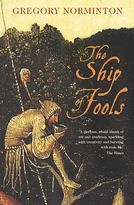
In the Ukrainian literature any productive discussion on the theme of the Book Literature did not yet take place. Although, bookmen-writers which all derive from Book (still, not from Life) we have more than enough here.
Englishman Gregory Norminton – almost young author of the "Ship of Fools" – is a pure bookman-writer. Still, this is a plus, not a minus, because the Author is so easily oriented in culture, styles, characters, intellectual streams of the past ages, that he creates some living and convincing artistic world. It is an example of feel-legs Book Literature determined by its style as so as definiteness, modesty and vivid force of details.
Why Nut?
Stories, told by its characters at the beginning and at the end of the novel, serve the same time as bait and as shell for the basic piece of the novel – that one about tower of smart guys. It is a colossal mega-metaphor for the mental life. Besides, its title which gives additional sense to content, hangs over the novel, etching unambiguity from it.
There just sea of paradoxes in that novel, as also plenty bright visions, deep opinions of meditative and philosophical plan. Here are just some of them: "All signs of time are absent. The time seems similarly absent”, „fear of silence is stronger than thirst”, „looks up as probably fishes watch”, „He copied Art due to Nature; did he copy Nature but without special Art”, „Silence has fallen down on the World – not a single sound flew from bank to water”, „Swallows flew above lake as though someone threw seeds overwater”, “would be written to inner emptiness”, „pitch-dark darkness in which even smells are lost”, „his lips itchy from an unexpected smile”, „Every art is a path away from reality, isn’t it? But reality is escape from truth that is from world of forms, accessible here only to me. Art spoils the soul, because it led away from truth, it exaggerates and lies, compels to feel dissatisfaction of self and life”, “not a crowd but just eyes”, „What indescribable happiness: to meet a goddess and suddenly understand that she is accessible for you”, „I heard the breath of his horse”, “by the echo of dead voices”, „juices of plant escape in root”, „when the storm of empty words calmed down”, „bathhouses of thermal springs long ago frappe by time”, „Talents of great people are needed always and anywhere where the battle for power goes on”, „dependence gives birth to offense”, „He, who put man to death, will not torture himself with doubts whether to snaffle or not”, „Time is intolerant to human life, because life distorts it”.
Norminton in every story by him puts before him a super-task – to demonize number three, to write a parody on great predecessors, to discover the character (lady, which failed in a Tartarus and cleaned that Tartarus to the stick) etc. Besides, the Author gives certain metaphors which can serve as formulas. Here, for example, there is a formula of Love: „I was his house and he was mine – and wherever he goes he constantly returns home. Ever”. And the story of manuscript of the owner of tower is a metaphor of the essence of writers’ trade, where the plastic itself is real but its essence is book. The Power is in combination of these two elements.
Norminton’s novel is a masterpiece not only of the contemporary English literature but the World’s literature also. That is why I expect from the Ukrainian dragomans a new translation of this work into my native language.
Roman KUCHARUK
(Translated from Ukrainian by Volodymyr Serdiuk)